Couture jewellery is often mistaken for jewellery turned up to maximum volume.
More diamonds. Larger gemstones. More complicated settings. More money.
Yet the most interesting high-jewellery ideas are rarely about quantity alone. They are about control. A great piece knows where the eye should begin, where it should move next, when colour should intensify, where metal should disappear and when a deliberate pause of empty space matters as much as another stone.
Those ideas do not belong only to extraordinary one-off jewels.
They can appear in a ring small enough to wear to dinner, in the rhythm of a diamond bracelet, in a pair of gemstone earrings or in a cluster setting where several modest stones are composed to create one coherent visual impression.
The useful question is therefore not “how do I make my jewellery look expensive?”
It is: what makes a piece look designed rather than merely decorated?
Table Of Contents
- Start With A Focal Point
- Colour Works Best When It Has A Role
- Mixed Cuts Create Rhythm
- Movement Is A Design Material
- Cluster Design Is About Architecture
- Metal Is Not Just The Background
- Negative Space Gives The Eye Somewhere To Rest
- Proportion Is What Makes Drama Wearable
- How To Borrow Couture Ideas Without Looking Overdressed
- The Difference Is Intention
- Explore The Jewellery
- Frequently Asked Questions
Start With A Focal Point
High jewellery usually gives the eye somewhere to land.
That focal point may be a magnificent centre stone, a sudden burst of colour, an unusual silhouette or a deliberate asymmetry. Everything around it then either supports, frames or contrasts with that decision.
In everyday jewellery, the same principle helps prevent visual noise.
A halo around a coloured gemstone works because the centre remains dominant. A three-stone ring works when the side stones strengthen the centre instead of competing with it. A pendant works when the chain, bail and setting quietly lead the eye towards the stone.
This is why “more stones” is not automatically more sophisticated. If every detail asks for equal attention, the piece can become visually flat despite being busy.
Couture influence begins with hierarchy.
Colour Works Best When It Has A Role
Colour in fine jewellery is not merely a matter of choosing a favourite gemstone. Our guide to fine jewellery colour trends in 2026 explores how those palettes are changing at a wider style level.
Designers use colour to create temperature, contrast, depth and mood.
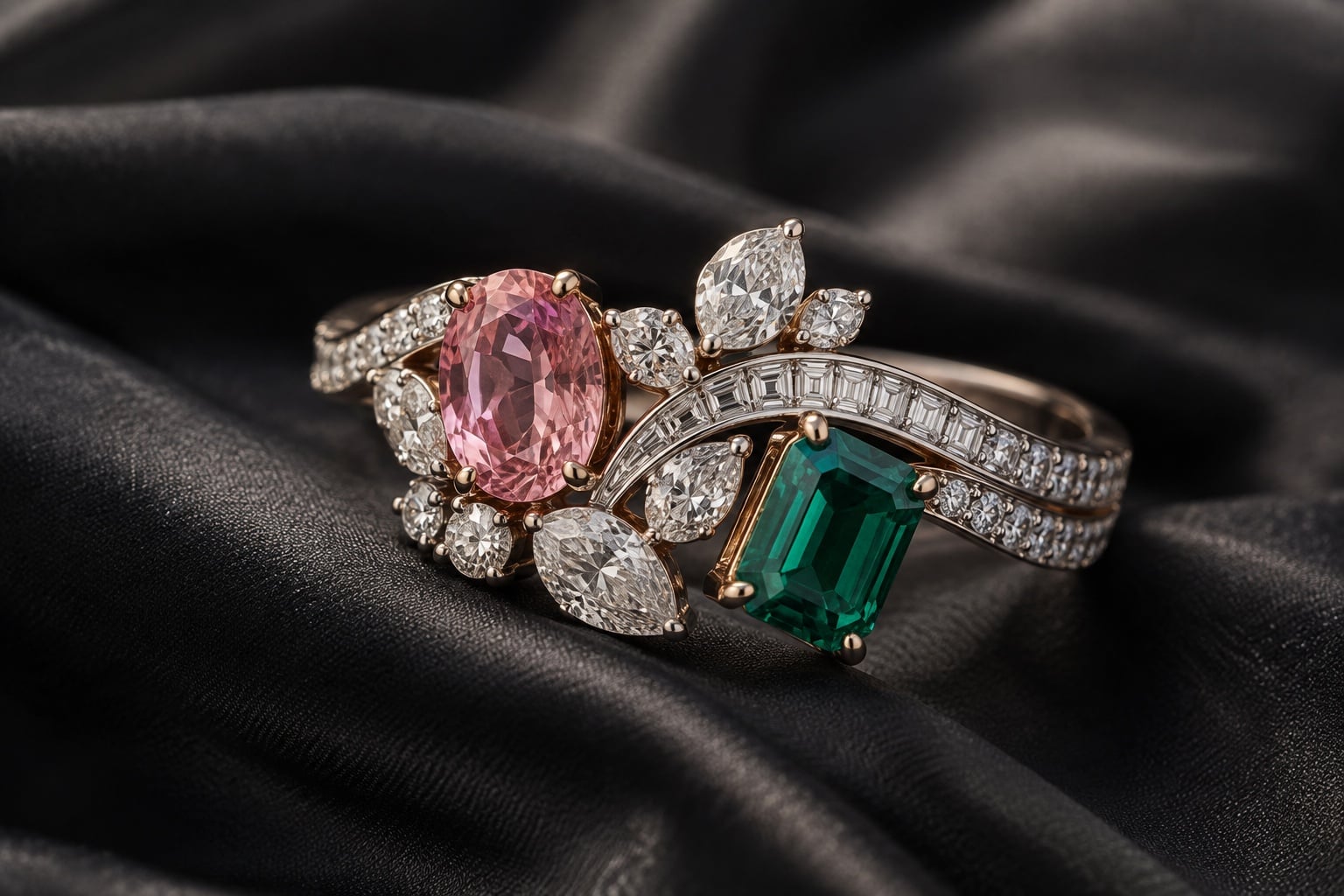
A cool emerald against white metal can feel crisp and architectural. A pink sapphire in rose gold can become softer because the metal echoes the stone’s warmth. A yellow diamond in yellow gold can intensify the centre colour because the mount supports it rather than creating a stark boundary.
Diamonds are particularly useful in these compositions because white brilliance can behave almost like light around colour. A diamond halo can sharpen the edge of a coloured centre stone. Small diamonds on the shoulders can carry that brightness away from the centre and prevent the design feeling visually isolated.
Colour Framing In A Wearable Ring
The Oval Pink Sapphire & Diamond 1.88ct Halo Ring in 18k Rose Gold demonstrates the effect neatly. An oval pink sapphire is framed by round natural diamonds, with further diamonds along the shoulders. The rose-gold setting keeps the overall temperature warm, so the contrast feels luminous rather than icy.

Design Example
Oval Pink Sapphire & Diamond 1.88ct Halo Ring in 18k Rose Gold
Pink sapphire, white diamonds and rose gold work as one warm colour composition, with the halo sharpening the centre while the shoulders carry light away from it.
Mixed Cuts Create Rhythm
One of the most powerful couture devices is also one of the easiest to overlook: changing the shape of stones changes the pace of the design.
Round brilliant diamonds produce repeated points of sparkle. Baguettes create lines and flashes. Pear shapes create direction. Marquise stones can pull the eye outwards. Step cuts feel calmer because the reflections are broader and more architectural.
Mixed together carefully, these cuts become a kind of visual punctuation. The same principle sits behind the art of diamond and gemstone pairings, where contrast is strongest when the stones have distinct visual jobs.
Art Deco jewellery used geometry with particular confidence. The V&A describes dense concentrations of gemstones and sharp geometric patterns as characteristic of the period, while surviving jewels often combine round stones with baguettes, calibré cuts and strong linear forms.
The lesson for modern jewellery is not to copy the 1920s. It is to understand why geometry remains so effective: shape gives light a structure.
Want To See How Colour Changes A Diamond Design?
Gemstone and diamond rings are a useful way to compare halos, metal colours, centre-stone framing and the balance between brilliance and colour.
Movement Is A Design Material
A ring is read mostly as a fixed composition. Earrings and necklaces can do something else.
They move.
An articulated drop catches light at different angles with every step. A pendant shifts against fabric. Flexible links in a bracelet change the way the diamonds present themselves as the wrist turns.
High jewellery has long used articulation to make stones appear almost alive. Christie's descriptions of important Art Deco jewels repeatedly emphasise movement, cascading baguettes and articulated drops because the motion is part of the design, not an accidental consequence of wearing it.
Wearable jewellery can borrow the same idea without becoming theatrical.
A short drop earring can create enough movement to catch the light beside the face. A flexible tennis bracelet feels different from a rigid bangle even when both contain a similar amount of diamond. A pendant with a small articulated element can change character as the wearer walks.
Earrings That Use Movement As Part Of The Look
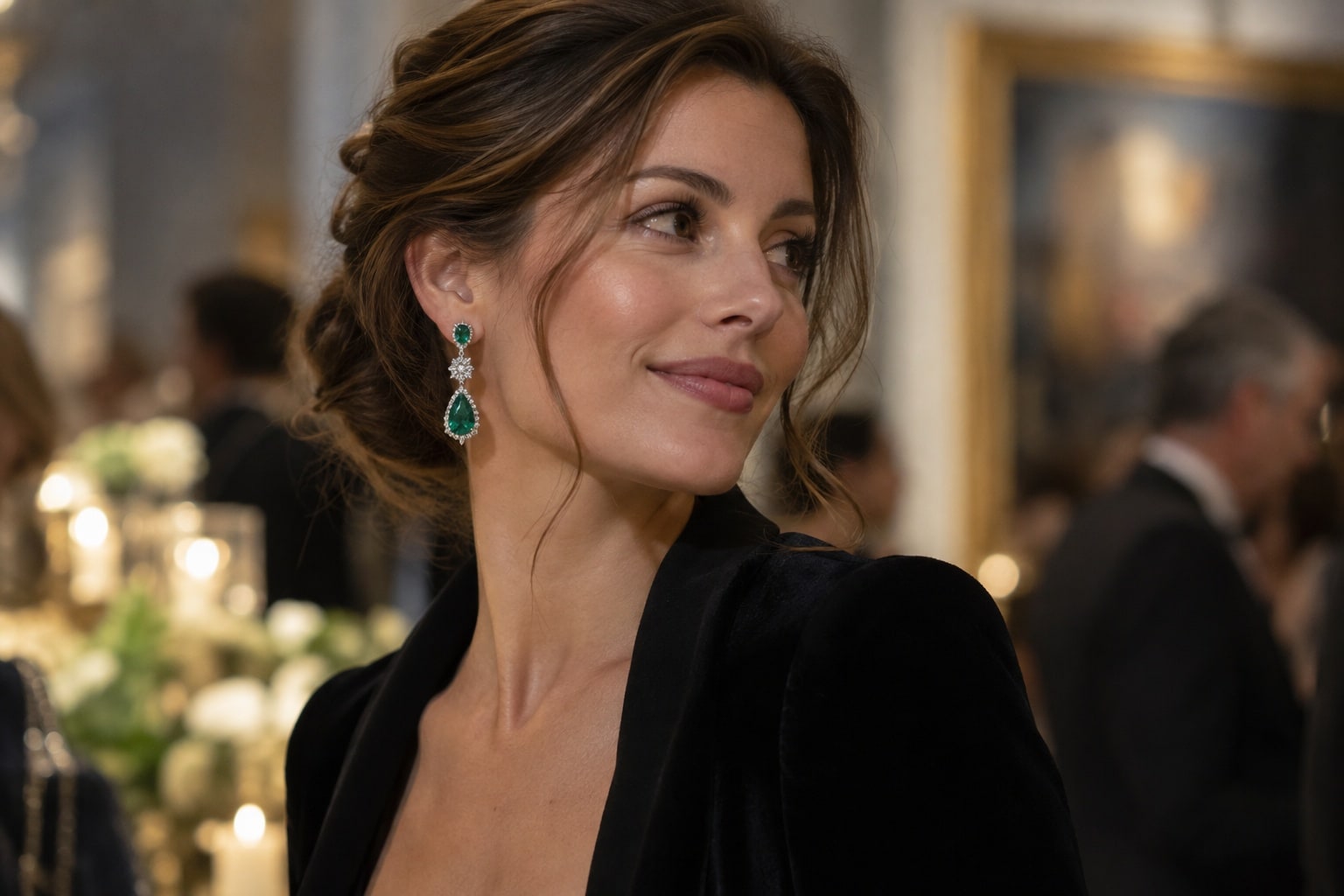
The 2.00ct Emerald & Diamond Drop Earrings in 18k White Gold combine natural emeralds and G/SI natural diamonds in a drop format. The point is not simply that they hang below the ear. The vertical arrangement allows colour and brilliance to shift with the wearer rather than remain visually fixed.

Design Example
2.00ct Emerald & Diamond Drop Earrings in 18k White Gold
Emerald and natural-diamond drops show how vertical composition and movement can turn colour into part of the wearer’s gesture rather than a static surface.
Cluster Design Is About Architecture
Clusters are sometimes treated as a way to imitate a larger single stone. That can be part of the effect, but the more interesting design question is how separate stones are organised into one shape.
A floral cluster reads differently from an oval cluster even when both use round diamonds. An illusion setting can increase the apparent visual area by controlling metal surfaces and spacing around smaller diamonds. A halo can either disappear into the centre composition or deliberately announce itself as a separate frame.
This is where craftsmanship becomes visible.
The eye may register “one flower” or “one burst of light”, but the jeweller has had to solve a series of small engineering problems underneath that impression.
Creating Scale Through Arrangement
The Diamond Cluster Floral Ring 0.50ct Look G/SI Quality in 9k White Gold is explicitly sold as a “0.50ct look”, not as a half-carat diamond ring. Its product specification lists 0.06ct of G/SI diamonds arranged in an illusion setting. That distinction is worth noticing because it shows exactly what design can do: visual scale can be created through composition without pretending that the carat weight is something it is not.

See The Detail
Diamond Cluster Floral Ring 0.50ct Look G/SI Quality in 9k White Gold
This floral head uses 0.06ct of G/SI natural diamonds in an illusion setting to create a deliberately larger 0.50ct-look visual impression.
Metal Is Not Just The Background
Metal colour changes how gemstones are read.
White gold and platinum can make white diamonds feel visually continuous with the mount, especially in pavé or halo work. Yellow gold creates a visible frame and can warm the whole composition. Rose gold brings a pink undertone that can soften both white diamonds and coloured stones.
But colour is only half the story.
The physical properties of the metal influence how finely a setting can be constructed, how prongs and channels are shaped, how a piece wears and how it can later be repaired. In good jewellery, the metal is doing visual and structural work at the same time.
Couture influence often appears when the designer understands when the metal should be noticed and when it should almost disappear.
Negative Space Gives The Eye Somewhere To Rest
This is perhaps the least expensive couture lesson because it requires adding nothing.
Space can make jewellery feel more sophisticated.
An open halo, a split shank, a curved gap between elements or a clean stretch of polished metal can give the eye a pause before the next flash of stone. Without those pauses, a complex design can become an undifferentiated surface of sparkle.
Art Nouveau jewellery used asymmetry and flowing lines to create this kind of breathing space in a different way from Art Deco geometry. If period detail appeals, the elegance of Edwardian jewellery shows another route to delicacy and structure. The historical references are very different, yet both demonstrate the same principle: a jewel is composed from stone, metal and space.
The space is not unfinished. It is part of the design.
Proportion Is What Makes Drama Wearable
High jewellery can be enormous because it is often created for exceptional occasions. Everyday fine jewellery has a harder job.
It has to work from conversational distance.
A dramatic ring must still allow the fingers to move comfortably. Earrings need to balance visual length against physical weight. A statement necklace has to cooperate with the neckline rather than fight it. A bracelet must articulate around the wrist without presenting its stones at awkward angles.
That is why simply miniaturising a high-jewellery piece does not always work.
Good wearable design rebalances the idea.
The centre stone may become smaller, but the colour contrast remains. The articulated fringe may become one moving drop. The dense pavé surface may become a narrow line that catches light at the edge of a ring.
The couture element survives because the design logic survives.
How To Borrow Couture Ideas Without Looking Overdressed
You do not need a gala to use these principles.
Choose one.
If you love colour, let one coloured gemstone lead and use diamonds as light around it. If you love geometry, look at baguettes, emerald cuts and structured halos. If you love movement, choose drop earrings or flexible bracelets. If you love romantic design, look for floral clusters, soft curves and asymmetry.
Then keep the rest of the jewellery quieter.
A couture-influenced ring can sit beautifully beside plain studs. Strong earrings often need very little at the neck. A diamond bracelet with unusual geometry can work with the simplest watch-free wrist.
The aim is not to reproduce a red-carpet jewellery suite.
It is to borrow the discipline behind one.
The Difference Is Intention
The most convincing jewellery often contains a detail you do not notice immediately.
A baguette placed where a round diamond would have been easier. A line of metal that narrows exactly where the colour needs to intensify. A drop that moves independently. A small gap that prevents the composition feeling heavy.
These are not necessarily expensive decisions. They are design decisions.
That is the couture lesson worth taking into ordinary fine jewellery.
A piece feels exceptional when every element appears to have a reason for being there.
Look For The Detail That Makes The Piece
Explore natural diamond and gemstone jewellery with an eye on proportion, colour, movement and the small design choices that turn sparkle into composition.
Frequently Asked Questions
What does couture jewellery mean?
In jewellery, “couture” is often used informally to suggest high-jewellery influence, exceptional design or one-off craftsmanship. There is no single gemmological definition, so it is more useful to look at specific design elements than the label itself.
Which design elements make jewellery feel more high-end?
Clear focal points, controlled colour, mixed cuts, movement, good proportion, thoughtful negative space and refined setting work can all make a piece feel more considered. Carat weight alone does not create that effect.
Do coloured gemstones work well with natural diamonds?
Yes. Diamonds can frame or contrast coloured gemstones, while metal colour can either intensify or cool the overall palette. The strongest combinations usually give one colour a clear leading role.
Why do jewellery designers mix diamond cuts?
Different cuts reflect light in different patterns and create different visual directions. Mixing rounds, baguettes, pears, marquise or step cuts can create rhythm and structure within a design.
Can couture-inspired jewellery be worn every day?
Yes, when the proportions, setting and comfort suit everyday wear. A couture idea can be translated into a smaller or simpler piece while retaining the colour relationship, geometry, movement or composition that gives it character.