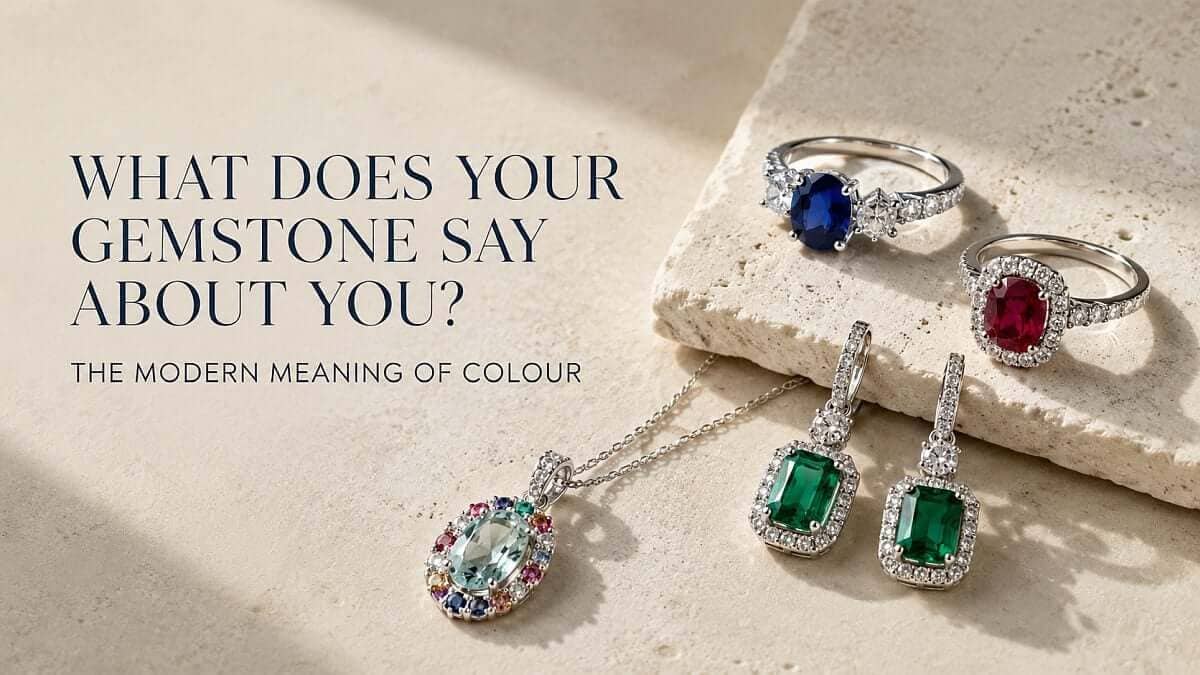

A gemstone can begin as colour and end as biography.
The emerald ring bought after a difficult year may come to mean recovery. A sapphire pendant chosen during a graduation trip can hold the atmosphere of that day long after the details have blurred. A ruby inherited from someone quiet and reserved may become a reminder that symbolism belongs as much to the wearer as it does to history.
This is why gemstone meaning is more interesting than a list of traditional associations.
Yes, sapphire has long been connected with truth and faithfulness. Ruby has carried ideas of passion and power. Emerald evokes growth, while aquamarine has centuries of watery imagery behind it. Those histories matter, but they are only the beginning.
A gemstone does not tell the world who you are.
It gives you a colour, a material and a visual language through which you may decide what you want to say.
A short guide to the inherited, visual and personal meanings carried by sapphire, ruby, emerald, aquamarine and multicolour gemstone jewellery.
Table Of Contents
- The Meaning Is Not Hidden Inside The Stone
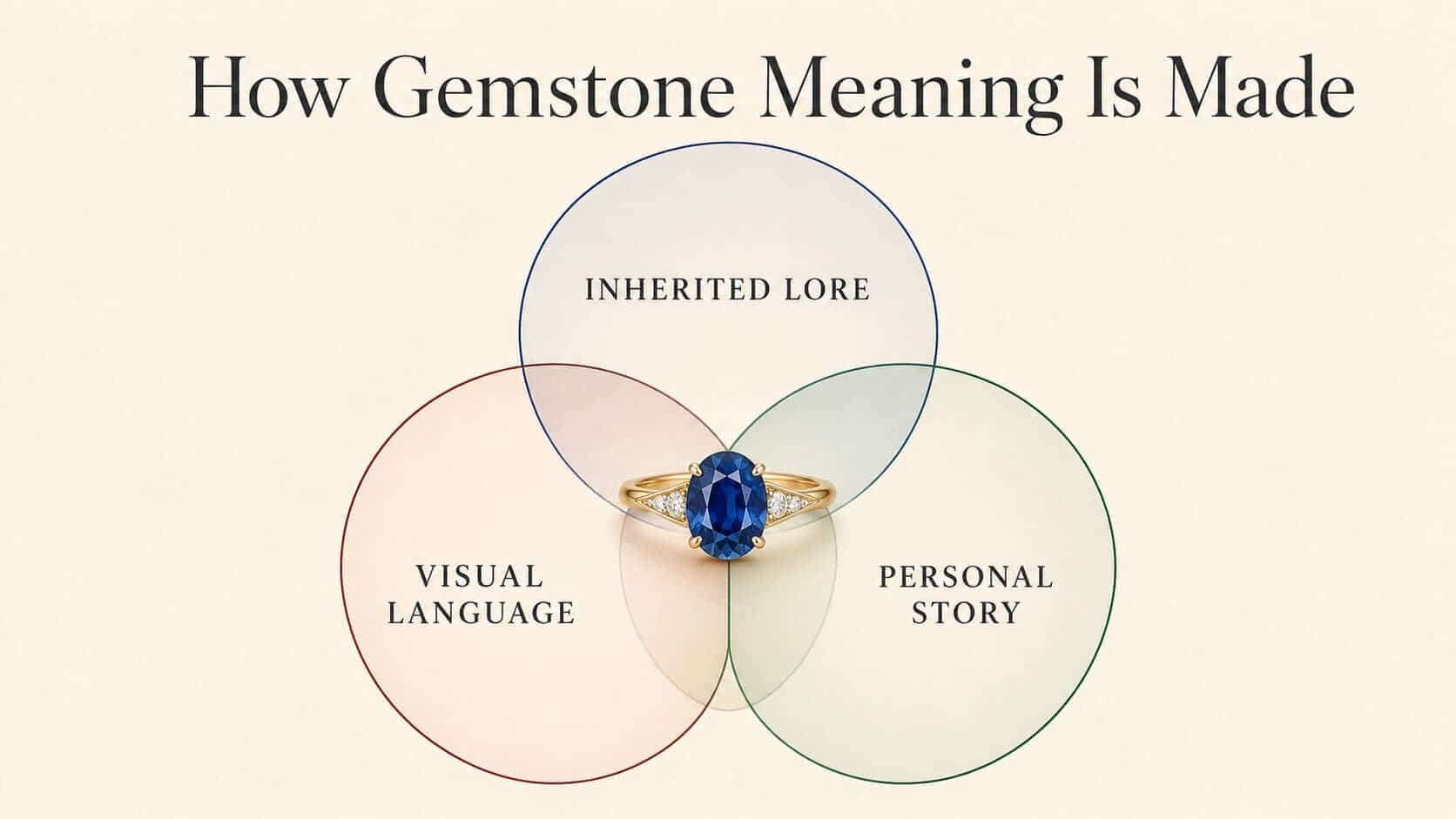
- The Three Layers That Give A Gemstone Meaning
- Blue Sapphire: Composure With Conviction
- Ruby: Presence, Energy And The Courage To Be Seen
- Emerald: Renewal With An Independent Streak
- Aquamarine: Clarity Without Coldness
- Pink And Multicolour Sapphires: Meaning Without A Rulebook
- What Natural Diamonds Add To The Message
- How Cut, Metal And Setting Rewrite The Meaning
- Public Symbol, Private Story
- How To Choose A Gemstone That Means Something To You
- Your Gemstone Does Not Need To Explain You
- Choose Colour With A Story Of Your Own
- Gemstone Meaning FAQs
The Meaning Is Not Hidden Inside The Stone
Ask what sapphire means and the usual answer is loyalty. Ask about ruby and you will hear passion. Emerald is renewal. Aquamarine is calm.
These associations are not simply modern marketing inventions, but neither are they universal laws.
A gemmologist can identify a mineral species, examine its colour and inclusions, consider its cut and determine whether treatments are present. Loyalty, courage and romance cannot be graded under magnification. They belong to culture, memory and interpretation.
Jewellery history makes this especially clear. The Victoria and Albert Museum records how, during the nineteenth century, coloured gemstones were matched to flowers so that jewellery could carry coded messages of love and friendship. Turquoise, for example, moved through associations with protection, health, reconciliation, love and fidelity as different societies and periods gave the stone new roles.
The meaning changed because the people using the jewellery changed.
That does not make gemstone symbolism meaningless. It makes it human.
The psychology behind why certain gem colours call to us is one subject. Symbolism is another. Colour may create an immediate visual or emotional response, but symbolism adds history, social convention and personal experience. The two can reinforce each other, but they should not be confused.
The Three Layers That Give A Gemstone Meaning
The most interesting gemstone jewellery usually carries more than one kind of meaning.
Inherited Lore
The first layer is the story already waiting for us.
Historic associations give a gemstone cultural weight. They explain why a sapphire engagement ring may feel faithful and ceremonial, why ruby suits romantic gifts and why green stones so often appear in jewellery connected with renewal.
We do not need to accept every legend literally to enjoy it. A story can enrich a jewel without becoming a claim about supernatural power.
In fact, old symbolism is often most appealing when treated with a little distance. It provides an echo rather than an instruction.
Visual Language
The second layer is created by what the eye sees.
A saturated red gemstone has a different presence from a pale blue one. A deep sapphire in a sharply geometric setting feels different from the same colour in a soft floral cluster. Yellow gold warms a gemstone. White gold or platinum tends to sharpen the contrast between the stone and its setting.
Even our perception of colour is not completely uniform. Gem-A notes that eyes differ and that individual tastes vary, even where there is broad agreement about desirable gemstone colours. Careful cutting and thoughtful jewellery design can also change how effectively that colour is presented.
This visual language does not produce a fixed dictionary. It creates an atmosphere.
Personal Story
The final layer belongs entirely to the wearer.
A gemstone may recall a person, a place, a promise, an achievement or a private turning point. It may be selected because it matches someone’s eyes, because it appeared in a grandmother’s ring or because its colour captures the landscape of a much-loved coastline.
This personal layer can support inherited symbolism, contradict it or replace it altogether.
A ruby does not have to mean romantic passion. It might mark professional courage. An emerald need not represent spring. It might recall a childhood garden. A sapphire chosen for an anniversary can come to represent a particular relationship even when the design itself is thoroughly contemporary.
Meaning becomes strongest when the stone’s history, its visual character and the wearer’s own story begin to align.
Blue Sapphire: Composure With Conviction
Sapphire carries one of jewellery’s most established symbolic traditions.
The Gemological Institute of America describes sapphire’s traditional associations with nobility, truth, sincerity and faithfulness. Its long use by royalty and the clergy gave blue sapphire a sense of legitimacy and ceremony that remains visible in jewellery today.
That heritage can make sapphire feel dependable, but it need not make it conservative.
A dark blue oval surrounded by diamonds may carry an unmistakably formal mood. Set in a cleaner rub-over design or repeated along a bracelet, sapphire becomes more graphic and self-possessed. The colour remains composed, but the jewellery no longer depends on historical romance for its identity.
Blue sapphire works particularly well for people who want colour with structure. It attracts attention without the visual heat of ruby and carries more depth than many paler blue gemstones.
Its message is not shyness.
It is conviction without noise.
Design Example
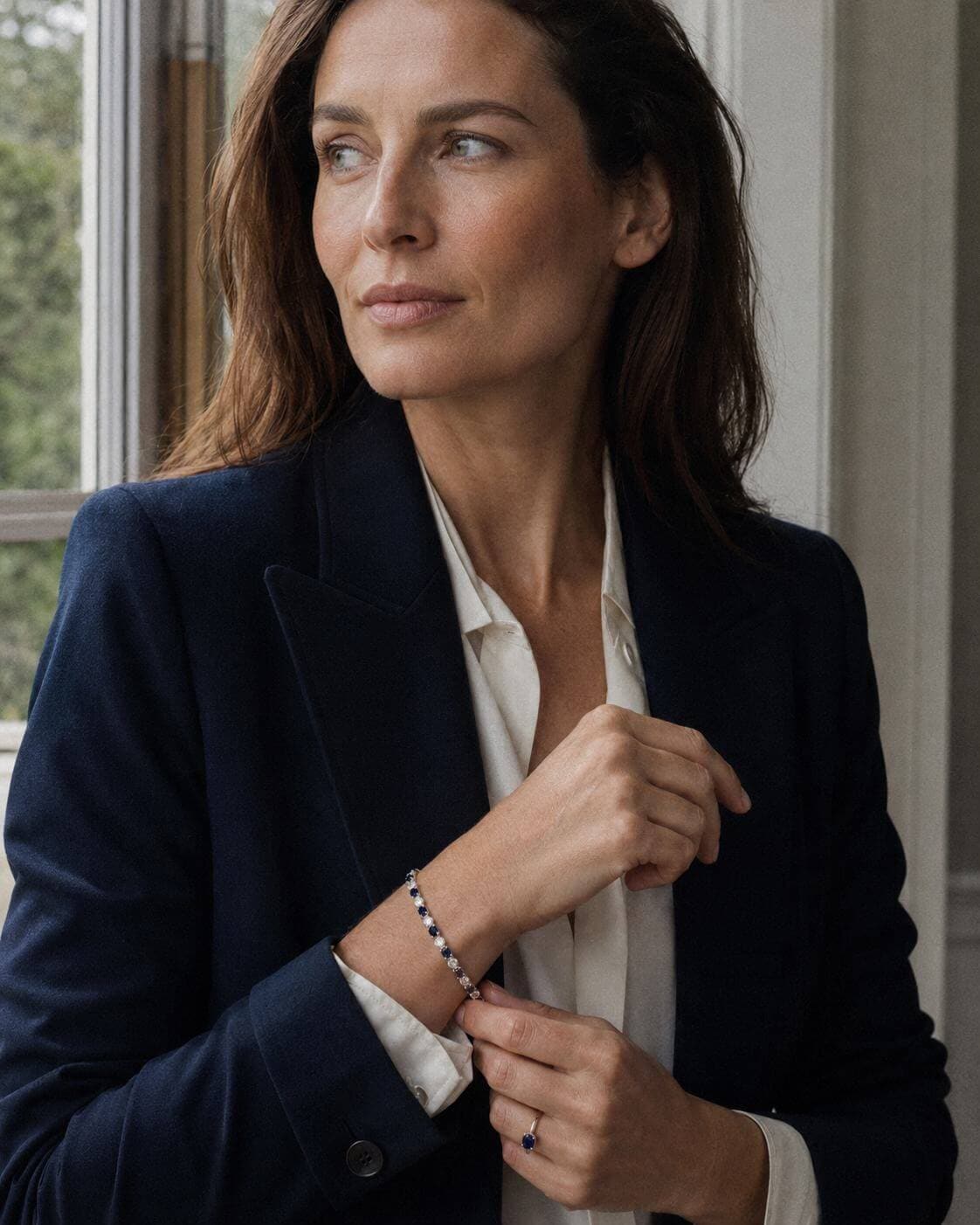
Sapphire & Diamond Tennis Bracelet 2.25ct in 18k Yellow Gold

A repeating line of sapphire and diamond gives sapphire’s old associations with fidelity a cleaner, more contemporary rhythm. In this 18k yellow-gold bracelet, 1.20ct of round sapphires are combined with 1.05ct of natural G/SI diamonds in rub-over settings. The yellow gold adds warmth, while the repeated pattern keeps the effect poised rather than ceremonial. The bracelet is UK-handcrafted and UK hallmarked.
Ruby: Presence, Energy And The Courage To Be Seen
Ruby does not behave like a background colour.
Its history is filled with images of life, heat, desire and authority. The ancient Sanskrit name ratnaraj translates as “king of precious stones”, while many earlier cultures associated ruby’s red colour with blood, vitality and the power of life. The GIA’s history and lore of ruby traces many of these associations.
Modern jewellery often reduces all of this to romantic passion. That is understandable, but incomplete.
Ruby can also represent appetite, visibility and personal resolve. It suits jewellery bought for oneself after an achievement just as naturally as it suits an anniversary gift. A small ruby may provide a precise flash of red within an otherwise restrained design. A larger ruby or expressive cluster makes a more deliberate statement.
The important distinction is between confidence and performance.
Ruby does not need an oversized setting to be expressive. The colour already has presence. A well-judged design can allow that presence to emerge without turning the piece into costume.
For someone who has spent years choosing jewellery designed not to be noticed, ruby can feel like permission.
Not permission to become another person, but to take up a little more visual space as oneself.
Find Your Colour, Then Find Your Setting
The gemstone may begin the story, but the setting determines how that story is told. Explore coloured gemstone jewellery in designs where natural diamonds, carefully chosen metals and considered proportions give each colour a distinct voice.
Emerald: Renewal With An Independent Streak
Emerald has inherited a particularly rich collection of meanings.
Its green has long been associated with spring growth. Older legends connected emerald with truth, eloquence and even the ability to foresee the future. These are stories rather than gemmological properties, but they show how consistently people have used emerald to represent perception, vitality and renewal. The GIA’s emerald history and lore records many of these traditions.
Yet emerald rarely feels as straightforward as the word “renewal” suggests.
Its colour can be lush, shadowed and complex. It feels cultivated without always feeling formal. Where sapphire may suggest composure and ruby immediate presence, emerald often carries a more individual kind of confidence.
It is an excellent stone for someone who appreciates tradition but does not want the most predictable interpretation of it.
An emerald engagement ring may represent a new beginning, but it may also be chosen simply because its green feels more personal than white diamond alone. Emerald earrings can bring colour to tailoring without overpowering it. A pendant can make the stone feel intimate, almost like a private emblem worn close to the body.
Emerald’s symbolism works best when it is allowed to remain slightly mysterious.
See The Detail
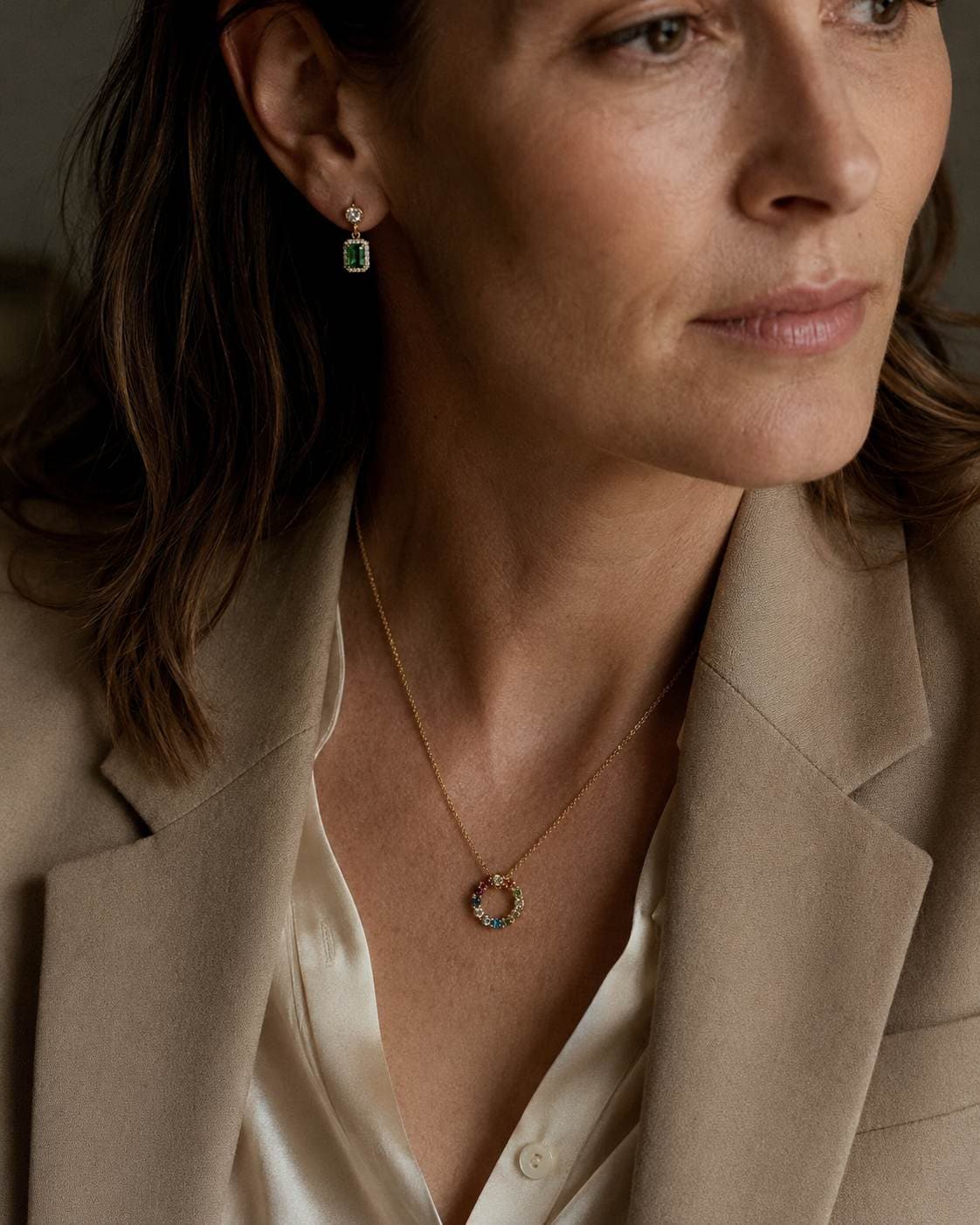
Diamond Halo Emerald Earrings 1.30ct Set in 9k Yellow Gold

These earrings show how design can edit symbolism. The 1.08ct of round emeralds supply the depth and living green, while 0.22ct of natural G/SI diamonds create definition around them. The yellow gold keeps the effect warm and wearable rather than austere. They are UK-handcrafted in 9k yellow gold and UK hallmarked.
Aquamarine: Clarity Without Coldness
Aquamarine’s meaning begins with its name.
It derives from the Latin words for water and sea, and its historical lore has included ideas of protection, intellectual clarity and the ability to face conflict successfully. The GIA’s aquamarine history and lore provides a useful overview of those traditions.
Its modern visual language is lighter.
Where sapphire has depth, aquamarine creates space. Its blue can feel open, airy and quietly reflective. This makes it attractive to people who want colour without heaviness and symbolism without an overly formal historical script.
Aquamarine is often described as calm, but calm should not be confused with passivity. There is a particular strength in clarity, especially when the stone is set in a design that avoids excessive sweetness.
A clean oval aquamarine in white gold can feel crisp and contemporary. Yellow gold introduces sunlight and warmth. Diamond accents give the pale blue a more deliberate edge, preventing the colour from disappearing into the metal or the skin.
Aquamarine may be linked with the sea, but the most successful aquamarine jewellery does not need shells, waves or other literal motifs.
The colour can carry the atmosphere by itself.
Pink And Multicolour Sapphires: Meaning Without A Rulebook
Sapphire is not only blue.
The corundum family includes fancy sapphires in pink, yellow, green, violet, orange, purple and intermediate shades. This range gives modern jewellery designers a much broader language than sapphire’s traditional blue identity might suggest. The GIA overview of sapphire explains the gemstone’s broad colour range.
Pink sapphire can carry romance, but it does so differently from ruby. It is often lighter, less declarative and more playful. Depending on the shade and setting, it may feel tender, contemporary or quietly unconventional.
Multicolour sapphire offers even more freedom.
Instead of asking one gemstone to carry a single idea, several colours can coexist within the same piece. The result may suggest abundance, individuality or change, but it does not require a formal interpretation.
This makes multicolour jewellery especially suitable for marking a life that cannot be reduced to one mood or milestone.
It can represent several people, several places or several chapters. It can also be chosen for the simplest and perhaps most convincing reason of all: the wearer enjoys the colours together.
Not every jewel needs a solemn explanation.
Sometimes delight is meaning enough.
A Style Worth Considering
Multi Sapphire and Diamond Pendant Necklace 1.20ct in 9k Yellow Gold

A multicolour sapphire piece refuses a single inherited code. This pendant combines 1.00ct of multicoloured sapphires with 0.20ct of natural G/SI diamonds in a circular 9k yellow-gold design. The repeated form holds the colours together, while the diamonds provide light and visual continuity. The UK-handcrafted pendant is supplied with a matching yellow-gold chain.
What Natural Diamonds Add To The Message
Coloured gemstones provide tone. Natural diamonds give that tone structure.
They can frame a centre stone, separate one colour from another or draw light around a gemstone that might otherwise appear dense. In a halo, diamonds make the centre stone feel more ceremonial. Alternated with sapphires in a bracelet, they create rhythm. Used as smaller accents, they sharpen the gemstone’s outline without competing for the main role.
Natural diamonds also bring their own cultural associations with commitment, permanence and lasting value. When they surround a coloured stone, some of that gravity is transferred to the design.
The result is not simply more sparkle.
Diamonds can make a colour feel intentional.
They tell the eye where to look and help the gemstone retain its presence as the jewellery moves through different light. This is particularly valuable with pale aquamarine, deep emerald or a collection of differently coloured sapphires.
The diamond and the gemstone do not need to carry the same message.
Their contrast is often what makes the finished piece compelling.
How Cut, Metal And Setting Rewrite The Meaning
Choosing a gemstone is only the first decision.
The same stone can tell a completely different story according to the way it is cut, framed and worn. This is why gemstone shapes and personality should be treated as design guidance rather than fixed character analysis.
Cut Is The Tone Of Voice
Round and oval stones tend to feel fluid and familiar. Step-cut gemstones appear more architectural because the eye follows their clean lines and broad planes. Pear shapes introduce movement and direction. A cluster creates abundance, while a single centre stone gives the colour more authority.
None of these shapes has a compulsory meaning.
They alter how the gemstone speaks.
A ruby in a soft oval may feel romantic. The same red in a geometric setting becomes sharper and more assertive. An emerald cut emphasises structure, while a rounded emerald surrounded by diamonds feels more decorative.
Metal Sets The Temperature
Yellow gold warms almost every gemstone. It can make blue sapphire feel richer, emerald more organic and ruby more opulent.
White gold and platinum create a cooler frame. They sharpen contrast and can give coloured stones a more formal or contemporary appearance. Rose gold introduces softness, particularly around pink gemstones and paler blues.
Matching a gemstone to its metal is therefore not simply a question of which combination is traditionally correct.
It is a decision about atmosphere.
The Setting Creates Posture
A claw setting leaves more of the gemstone visible and can make the design feel lighter or more traditional. A halo increases definition and ceremony. A rub-over setting gives the stone a cleaner outline and can feel more graphic, modern and controlled.
The setting also has a practical role. Jewellery worn every day needs to suit the wearer’s routines, and a ring places different demands on a gemstone from earrings or a pendant.
Meaning lasts longer when the jewellery can be worn with confidence.
Public Symbol, Private Story
Jewellery has a public life.
Other people may read a sapphire engagement ring as commitment, a ruby cocktail ring as confidence or an emerald pendant as evidence of individual taste. Jewellery communicates before its wearer explains it, which is why it has always worked so effectively as a power symbol and marker of identity.
Yet the private story may be completely different.
The ruby ring that looks bold across a dinner table might have belonged to a reserved grandmother. An emerald bought after recovery from illness may appear decorative to everyone except the wearer. A sapphire bracelet can publicly suggest elegance while privately recalling a relationship, place or promise.
The two meanings do not compete.
Their coexistence is one of fine jewellery’s strengths.
A piece can be legible enough to carry cultural meaning and personal enough to keep part of its story hidden. This is often how jewellery becomes emotionally valuable. It remains beautiful to others while becoming irreplaceable to one person.
That private meaning may eventually change again. Jewellery that begins as a personal purchase can become an heirloom. A stone selected for its colour may acquire a family history. The next wearer may preserve the original story, add another or interpret the gemstone in an entirely new way.
Symbolism is not fixed because jewellery continues to live.
How To Choose A Gemstone That Means Something To You
The best place to begin is not with a chart.
Begin with attention.
1. Which Stone Do You Keep Returning To?
Notice what holds your eye after the first impression has passed.
It is easy to admire many gemstones briefly. The more useful clue is the colour you continue to revisit. This may be a deep inky sapphire, a clear aquamarine, a vivid ruby or an emerald with a softer, more garden-like green.
Repeated attraction is often more revealing than a formal symbolism guide.
2. Do You Want An Inherited Meaning Or A Private One?
Some people enjoy choosing a gemstone with a widely recognised history. Sapphire’s connection with fidelity may make it especially appropriate for an engagement or anniversary. Emerald’s association with renewal may suit a new chapter.
Others prefer a meaning that belongs only to them.
Neither approach is more authentic. The distinction simply helps you decide whether you want the stone’s story to be immediately understood or quietly personal.
3. Which Version Of The Colour Feels Right?
Gemstone names cover an enormous range of visual experiences.
Not every sapphire has the same blue. Rubies vary in tone and saturation. Emeralds can appear bright, deep or softly included. Aquamarines range from very pale blue to stronger sea-like shades.
Choose the individual colour rather than the generic idea of the gemstone.
A person who feels overwhelmed by a dark blue sapphire may love a lighter one. Someone who assumes pink is too delicate may respond differently to a saturated pink sapphire with crisp diamond accents.
4. What Design Speaks In Your Voice?
The gemstone should not be considered separately from the jewellery.
Someone with a restrained wardrobe may enjoy a vivid colour in a clean setting. A more romantic dresser may prefer clusters, halos or softly shaped stones. A person who mixes metals and colours freely may find a multicolour sapphire piece more natural than a single traditional gemstone.
This is also why birthstone jewellery should be treated as an invitation rather than an instruction. You may choose the stone connected to your month, but you are equally free to choose one connected to your taste, history or imagination.
5. Will It Suit The Life You Actually Live?
Meaning is not helped by jewellery that remains permanently in its box.
Consider how often the piece will be worn, where it will be worn and how much exposure it will receive. Earrings and pendants usually face fewer knocks than everyday rings. Some gemstones and settings require more careful wear than others.
Ask about care, durability and the protection provided by the setting before making a final decision.
Practical suitability does not diminish romance. It allows the gemstone to gather the experiences that eventually make its symbolism real.
Your Gemstone Does Not Need To Explain You
A gemstone meaning guide can provide a beginning.
It may explain why sapphire became associated with fidelity, why ruby carries centuries of intensity or why emerald so easily evokes renewal. It can reveal the cultural stories already surrounding a colour.
What it cannot do is decide what the jewellery will mean once it belongs to you.
That part develops through choice, wear and memory.
The most meaningful gemstone is rarely the one that obeys a symbolism chart most perfectly. It is the one whose inherited echoes, visual character and personal story come together in a way that feels natural to the wearer.
Choose the colour that continues to hold your attention.
Choose the design that gives it the right voice.
Then allow life to add the rest of the meaning.
Choose Colour With A Story Of Your Own
Explore sapphire, ruby, emerald, aquamarine and multicolour gemstone jewellery set with natural diamonds. Look beyond a gemstone’s traditional definition and choose the colour, design and atmosphere that feel capable of becoming part of your own story.
You can also explore blue sapphire and diamond rings, ruby and diamond rings, emerald and diamond rings, aquamarine and diamond rings, and multicolour sapphire and diamond rings.
Gemstone Meaning FAQs
Do gemstones have fixed meanings?
No. Gemstones have accumulated cultural and historical associations, but those meanings differ across places and periods. The wearer’s personal connection to the jewellery may become more important than any traditional definition.
Which gemstone traditionally symbolises loyalty?
Blue sapphire is traditionally associated with truth, sincerity and faithfulness, which is one reason it has remained popular in engagement and anniversary jewellery.
Which gemstone is associated with renewal or new beginnings?
Emerald is commonly connected with renewal because its green colour evokes spring growth. This is a symbolic association rather than an inherent property of the stone.
Must I choose the gemstone linked to my birth month?
No. A birthstone can provide a meaningful starting point, but you may choose any gemstone for its colour, symbolism, design or personal relevance. The jewellery is more likely to be worn and enjoyed when the choice feels genuinely yours.
Does the precious metal change a gemstone’s meaning?
The metal changes the gemstone’s visual impression rather than its historical meaning. Yellow gold tends to add warmth and richness, while white gold or platinum often creates a cooler, sharper contrast. Rose gold may make the design feel softer.
Can a coloured gemstone be used in an engagement ring?
Yes. Sapphire, ruby, emerald, aquamarine and other gemstones can all appear in engagement rings, but their care requirements differ. The stone, setting and wearer’s lifestyle should be considered together, particularly when the ring will be worn every day.